Empowering undergraduate students to lead high-impact research through active learning, spaced repetition, and AI.
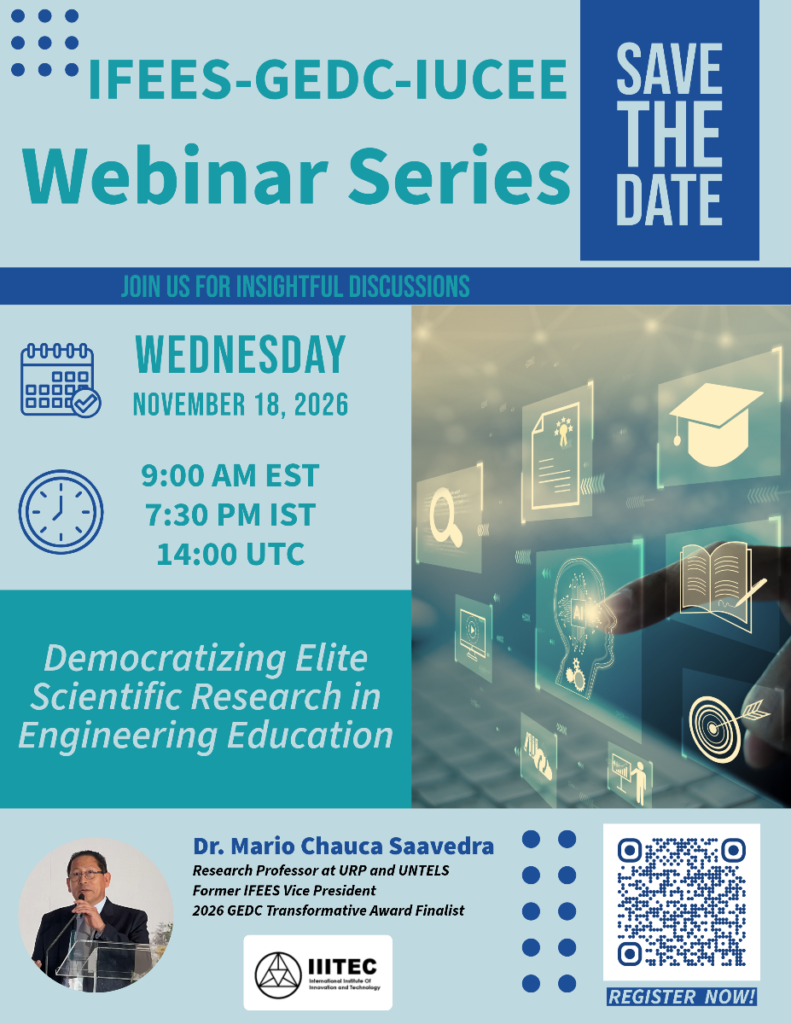
In many emerging economies, high-level scientific research and publication in Scopus- or Web of Science-indexed journals are often seen as opportunities reserved for postgraduate students. This presentation introduces an approach called “Active Action in Spaced Repetitions with AI,” which supports undergraduate students—starting as early as their fifth semester—in leading research, publications, and patentable innovations.
The approach combines active, hands-on learning with structured review cycles and AI-assisted research and technical writing. Students work on real-world challenges, while human judgment and decision-making remain central. The presentation will share examples from applications in regions including the Peruvian Amazon.
The initiative reports more than 62 co-authored student articles and a 90.38% acceptance rate for publications in Scopus- and Web of Science-indexed venues. Other examples include student research presented at IEEE MWSCAS, a 2022 invention patent for a medical telemetry bracelet, and programs reaching more than 5,000 students, over 35% of whom are from rural areas and the Amazon region.
The presentation will also discuss how this model supports SDG 4: Quality Education and SDG 9: Industry, Innovation and Infrastructure. The presenter’s “Memory Activation through Cyclic Habits” model is designed to be adapted across curricula and scaled through IFEES and GEDC member institutions.
About the Presenter
Dr. Mario Chauca Saavedra is an electronic engineer and PhD in Education, a Research Professor at Universidad Ricardo Palma and UNTELS, and a former Vice President of IFEES. He received the 2021 Global Engineering Education Award and is a RENACYT researcher with more than 62 Scopus- and Web of Science-indexed articles. He has served on the IEEE MWSCAS Steering Committee since 2010 and is the creator of the “Active Action in Spaced Repetitions” methodology. His work includes a 2022 invention patent for a medical telemetry bracelet and advancing research opportunities for undergraduate students.